Social Security Disability Approval Rates (2025)
The Social Security Administration has published its annual “waterfall chart” showing the 2025 approval rates at each step of the Social Security disability claims process. As in previous years, claimants had the highest approval rates following hearings before Administrative Law Judges.
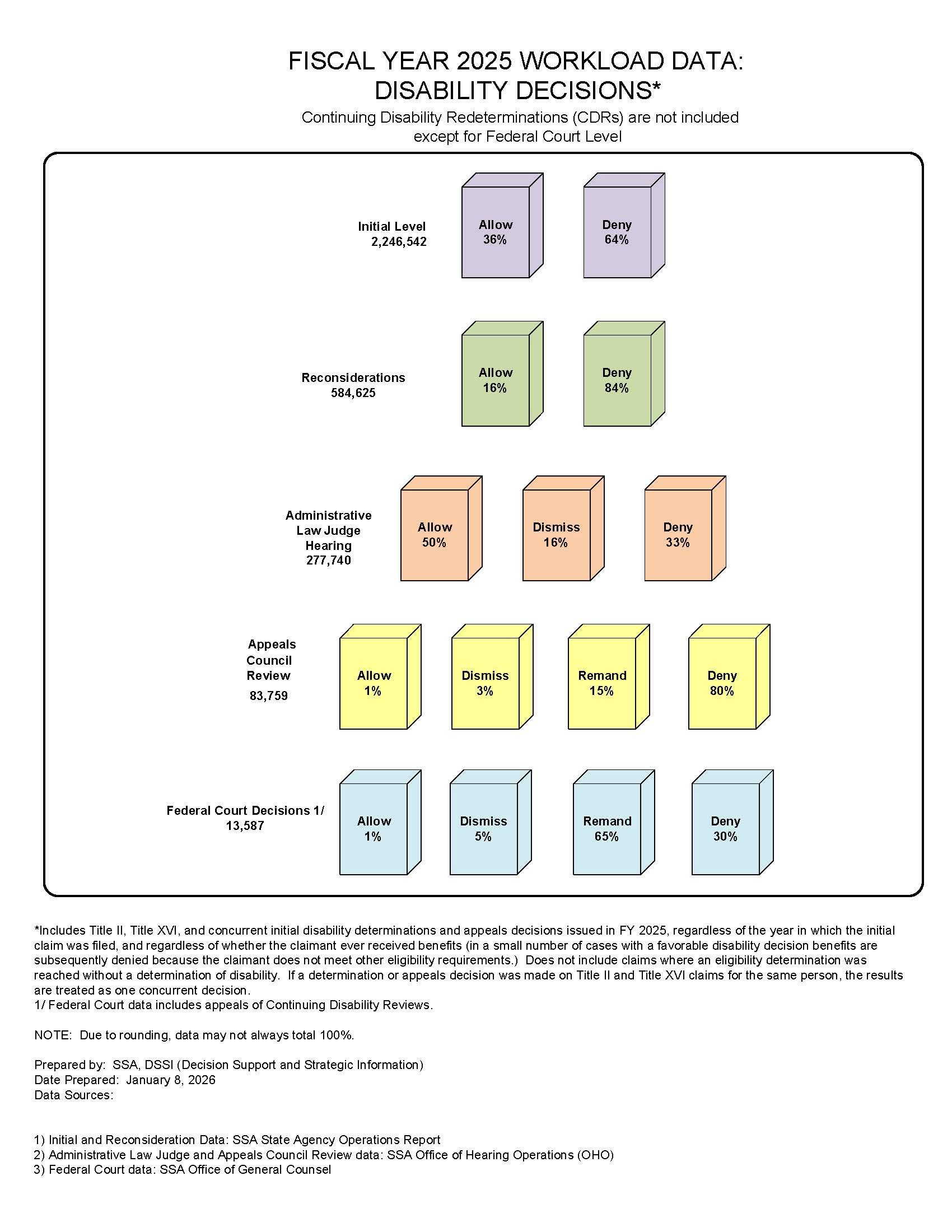
Each year, the Social Security Administration’s annual “waterfall” chart gives claimants and representatives a quick look at how disability cases are resolved at each stage of the process. The FY 2025 chart shows a familiar pattern: most claims are denied early, but approval rates improve significantly once a case reaches an Administrative Law Judge. According to SSA, 36% of claims were allowed at the initial level and 64% were denied. At reconsideration, only 16% were allowed, while 84% were denied.
The hearing level remains the most favorable point in the administrative process for many claimants. In FY 2025, Administrative Law Judges allowed 50% of cases, while 33% were denied and 16% were dismissed. By contrast, the Appeals Council allowed just 1% of cases outright, while 15% were remanded, 80% were denied, and 3% were dismissed. At the federal court level, 1% were allowed, 65% were remanded, 30% were denied, and 5% were dismissed, showing that federal court review more often results in another chance to be heard than an immediate award of benefits.
The chart also reflects the scale of the disability system. SSA reported 2,246,542 initial decisions, 584,625 reconsideration decisions, 277,740 ALJ hearing decisions, 83,759 Appeals Council decisions, and 13,587 federal court decisions in FY 2025. It is hard to overstate how many claims are filed each year: there are about 414,000 federal lawsuits filed each year, so there are more than five times as many Social Security disability claims as federal lawsuits in the United States.
Compared to recent years, FY 2025 had broadly similar approval rates at each step of the process, but with a few moderate shifts. The initial approval rate slipped from 39% in FY 2023 to 38% in FY 2024 and 36% in FY 2025, while the reconsideration approval rate moved from 15% in FY 2023 to 16% in both FY 2024 and FY 2025. At the hearing level, the approval rate rose from 45% in FY 2023 to 51% in FY 2024, then edged down to 50% in FY 2025. Appeals Council outcomes stayed relatively stable, with only 1% allowed outright in all three years, while federal court remand rates remained high at 61% in FY 2023, 63% in FY 2024, and 65% in FY 2025. In other words, the big picture has not changed: early denials remain common, hearings continue to offer the best chance of success, and higher appeals most often produce remands rather than direct awards. Sadly, we still see more denials than in the distant past: We have still never recovered from the 2010 Social Security Administration “retraining” initiative that lowered approval rates.
For disability applicants, the takeaway is clear. The FY 2025 waterfall chart underscores that an initial denial is not the end of the road. Many meritorious claims are denied in the early stages, and the hearing level continues to be the stage where claimants have their strongest opportunity to secure a favorable result.
Keep in mind, of course, that different claims have different chances of success. Some claimants have very serious medical conditions and have relatively higher chances of success, while some claimants with less clear medical profiles might have lower chances of approval.
At the risk of sharing self-serving information, we think it is worthwhile to note that attorneys have been shown to massively increase approval rates: The Government Accountability Office has found that claimants who had representatives, such as an attorney, were allowed benefits at a rate nearly 3 times higher than those without representatives. A National Bureau of Economic Research paper also found that “Legal representation increases the probability of initial award by 23 percentage points,” and decreases average processing time by 316 days.
Disclaimer: The information provided in this blog is for general informational purposes only and does not constitute legal advice. Reading this blog does not create an attorney-client relationship. For advice specific to your situation, please speak directly with a Social Security disability lawyer.