What Is Substantial Gainful Activity (SGA)?
What Is Substantial Gainful Activity? | SGA and Disability
Substantial gainful activity, usually called SGA, is the legal standard that the Social Security Administration uses to evaluate whether your work and earnings affect eligibility for disability benefits. A useful shorthand is that the Social Security Administration defines disability in terms of an inability to work, so it has to ask whether you are currently working. If you are working, that may indicate that you are not disabled under the agency’s rules. Because “working” is ambiguous, the Social Security Administration adopted the legal term “substantial gainful activity” as the effective standard for deciding whether you are working too much to receive disability benefits.
In most instances, the Social Security Administration uses a presumptive threshold of gross earnings to determine whether you are engaged in SGA. In 2026, the presumptive threshold for SGA is $1,690 for most disabled individuals and $2,830 for statutorily blind individuals. If you earn more than those amounts, you are presumptively engaged in SGA; if you earn less than those amounts, you are presumptively not engaged in SGA. In other words, it is consistent to argue that you are disabled but can still work a little bit. To return to that shorthand, it is more accurate to say that the Social Security Administration defines disability in terms of an inability to sustain work at a substantial level, so it has to ask whether you are currently working at that level.
In most cases, the Social Security Administration simply looks at those presumptive thresholds. But in some cases—especially when someone is self-employed—the Social Security Administration also looks at additional factors, such as the kind of work performed, whether the work is subsidized, and whether there are impairment-related work expenses. And if a return to work is short-lived, the Social Security Administration asks whether it qualifies as an unsuccessful work attempt under 20 C.F.R. § 404.1574(c).
Two practical notes:
First: In practice, SGA sometimes works a little differently for someone still applying for disability benefits than for someone already receiving disability benefits. At many hearings, I see Administrative Law Judges apply POMS DI 10505.015 and average earnings over multi-month periods; accordingly, if your work only slightly exceeds the SGA threshold for a month or two, they might still determine that you are not engaged in SGA. But people also call my office years after approval with issues based on exceeding the SGA threshold for just one month; they are usually safe once trial work period rules apply. The rules are not formally different, but the practical effects can be.
Second: The government recently rescinded a number of policy statements on how it interpreted substantial gainful activity. I have noticed a practical difference in only one case, but we may see mild changes in the future if the government issues new policy statements soon.
What does substantial gainful activity mean?
In this context, a good text-based legal interpretation helps explain the concept: substantial gainful activity has to be (1) substantial, (2) gainful, and (3) activity.
Substantial
By regulation, the Social Security Administration uses “substantial” to mean work that involves significant physical or mental activities. The emphasis should be on significant. In short, if you are working only a little bit, your work may not be “significant,” and therefore may not be “substantial,” and therefore may not be SGA. In other words, you can receive disability benefits and still work a few hours a week.
Gainful
The Social Security Administration uses “gainful” to refer to work usually done for pay or profit. In other words, the Social Security Administration will usually not consider volunteer work or hobbies to be gainful—they are not the type of activities usually done for pay—so they generally are not SGA. In fact, by regulation, the Social Security Administration says it generally “do[es] not consider activities like taking care of yourself, household tasks, hobbies, therapy, school attendance, club activities, or social programs” to constitute SGA.
Activity
“Activity” means the performance of significant physical or mental activities in work—not simply receiving money from investments or gifts from family and friends. A common tricky issue involves disabled former insurance agents who receive ongoing commissions for past work. The insurance agent might receive substantial earnings from profit-seeking behavior, but they are, at least arguably, not engaged in activity because they may not be doing anything anymore. Sometimes insurance agents are still found to be engaged in activity, however, if they continue helping clients with claims.
What is the presumptive SGA amount for 2026?
The Social Security Administration’s current monthly thresholds for presumptive SGA are:
- $1,690 for non-blind disabled individuals
- $2,830 for statutorily blind individuals under Social Security disability rules
The Social Security Administration updates these figures over time. Please note that these thresholds are based upon pre-tax earnings!
These thresholds do not always mean the SGA question is easily resolved based on a paycheck stub. Depending on the facts, the Social Security Administration may need to account for deductions, special conditions, or work incentives before deciding whether work activity rises to the SGA level.
Why SGA matters in disability cases
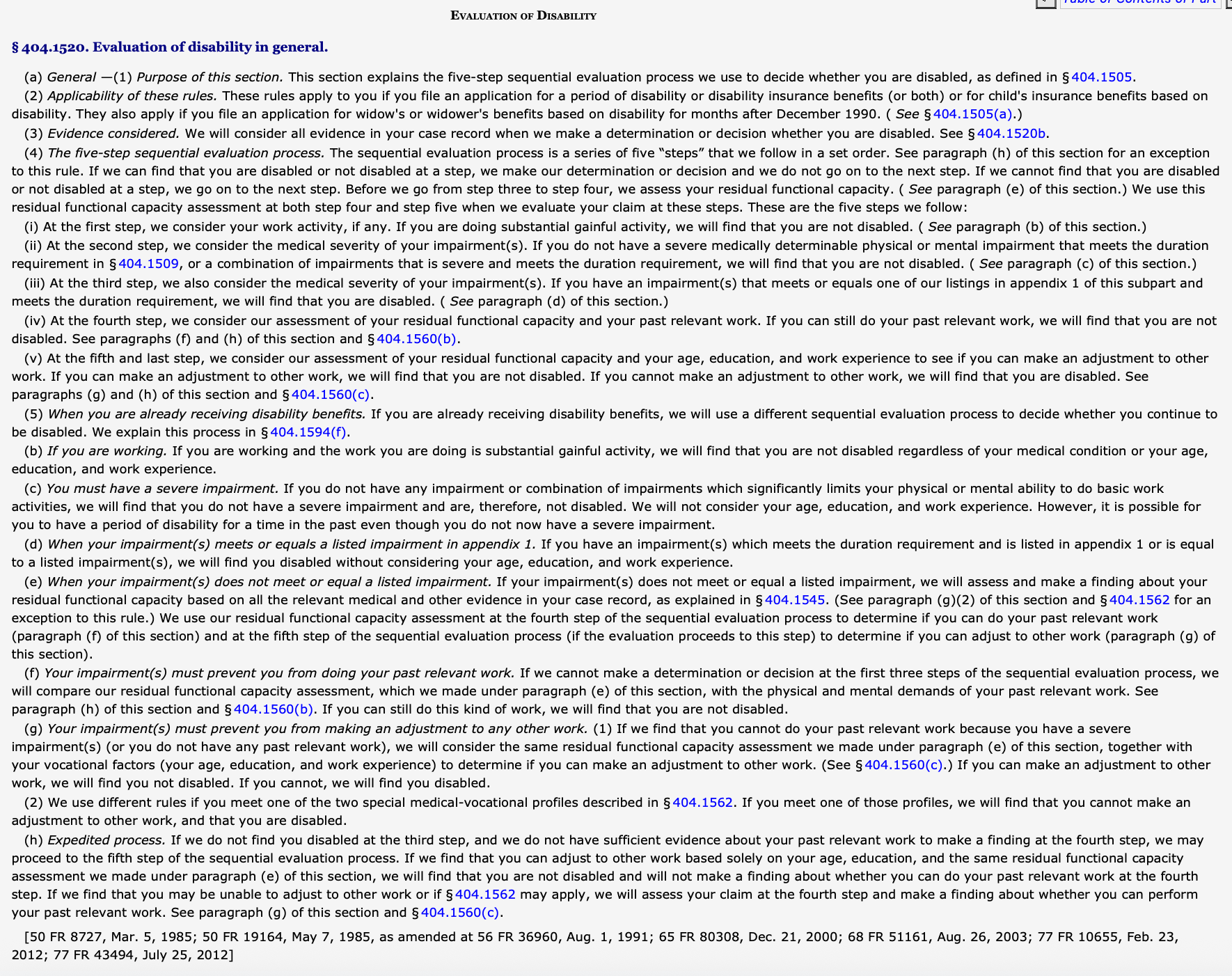
As part of the five-step sequential process for resolving disability claims, the Social Security Administration asks whether you are performing substantial gainful activity. If so, you are not disabled, and the inquiry ends without proceeding to any medical analysis.
What kinds of work can count as SGA?
A wide range of work can potentially count as substantial gainful activity, including:
- part-time work
- temporary or seasonal work
- self-employment
- freelance work
- rideshare or delivery work
- office work
- manual labor
If you are preparing a claim or appeal, your work history often matters well beyond the SGA issue.
Does unpaid activity ever matter?
Usually not for SGA purposes, though it often matters for the medical assessment.
After determining that someone is not engaged in SGA, the Social Security Administration proceeds through the remaining steps of the five-step sequential process. As part of those steps, the Social Security Administration makes a holistic review of the person to determine functional capacity. Even if some unpaid activity is not legally SGA, and the claim proceeds to medical review, a substantial amount of unpaid activity might still show the capacity to work and weigh against a disability claim. For example, I have never seen an Administrative Law Judge find that someone was engaged in substantial gainful activity because they were a full-time stay-at-home parent. But it is very common for an Administrative Law Judge to refer to someone’s significant childcare responsibilities as indicative of an ability to work. Issues like that often arise at Social Security disability hearings.
What income does not count as SGA?
Not all income counts as substantial gainful activity. SGA is about work activity and earnings from active work, not passive income by itself. For example, if you receive dividends from stocks that you own, that is almost certainly not SGA.
How SGA works for SSDI
For SSDI, the presumptive SGA amount is the important threshold. If someone receiving SSDI begins working above the applicable SGA level, benefits can eventually be affected unless a work incentive or exception applies.
The Social Security Administration also provides a trial work period for disability beneficiaries. In 2026, a month generally counts toward the trial work period when earnings exceed $1,210. The Social Security Administration says the trial work period allows beneficiaries to test their ability to work, and it does not apply to SSI.
How earnings and SGA work for SSI
SSI is more complicated because earnings matter both for purposes of qualifying as disabled and—if a person is found disabled—for determining how much in monthly benefits that person receives.
Earnings can reduce SSI benefits regardless of whether someone is engaged in SGA. Because SSI is a need-based program, it reduces benefits dollar-for-dollar for unearned income. As an oversimplified example, if someone gives you $100, then the Social Security Administration assumes you have $100 less in need and will reduce SSI benefits by $100. In practice, however, the SSI program incentivizes work. Under the Social Security Administration’s Red Book, there is a $20 general income exclusion, a $65 earned-income exclusion, and then exclusion of one-half of the remaining earned income. So, after the initial $85 of exclusions, SSI benefits generally reduce by $1 for every $2 earned. None of these reductions involves an SGA determination.
As with SSDI, the Social Security Administration can determine that someone is not disabled for SSI purposes if they are engaged in SGA. But after a person has been eligible to receive benefits for at least one month, Section 1619(a) allows some people to continue receiving SSI cash payments even when earned income exceeds the SGA level. That is why it is too simplistic to say that earning above the monthly SGA amount always ends SSI immediately.
What are impairment-related work expenses?
Impairment-related work expenses, often called IRWEs, are certain out-of-pocket costs for items or services a person needs in order to work because of a disability. The Social Security Administration says these may include items such as medical devices, service animals, attendant care, some transportation costs, and certain modifications needed for work. These expenses can matter because allowable deductions may reduce the earnings the Social Security Administration uses in the SGA analysis.
People often get tripped up on IRWEs by failing to show that their expenses are actually impairment-related. It is not enough simply to have work expenses.
What is subsidized work?
Subsidized work, more formally described as work performed under special conditions, generally refers to a situation in which a person is paid more than the actual value of the work performed because of added support, reduced productivity expectations, or special conditions on the job. In those situations, the Social Security Administration may look beyond the wage paid and consider the true value of the work. As a simplified example, some companies employ people with significant developmental disabilities in what some call sheltered employment. While section 14(c) of the Fair Labor Standards Act authorizes companies to pay subminimum wage to these employees, some companies still elect to pay the minimum wage, or even a living wage. Even more commonly, we see family-owned small businesses employing disabled family members to provide purpose and support. In each instance, the Social Security Administration might accept that the work is subsidized and does not count as SGA, even if earnings exceed the presumptive SGA thresholds. In cases like those, it is often important to have the employer complete Form SSA-3033.
What if someone tried to work but had to stop?
The Social Security Administration recognizes that disabled people often still have a strong work ethic and may try to work, but quickly fail because of their disabilities. The Social Security Administration calls these unsuccessful work attempts. In general, work may be treated differently if it ended, or dropped below the non-SGA level, within 6 months because of the impairment or because special conditions were removed. The Social Security Administration also states that SGA-level work lasting more than 6 months cannot be treated as an unsuccessful work attempt.
One additional note: The Social Security Administration recently rescinded SSR 84-25 because it was supplanted by 20 C.F.R. § 404.1574(c). SSR 84-25 defined different criteria for unsuccessful work attempts that ended within 3 months and those that ended within 6 months. If you find an adjudicator stuck in the old way of doing things and still applying SSR 84-25, that may be a strong issue for appeal.
Can work below the SGA amount still cause problems?
Yes. The monthly SGA amount matters, but it is not the only issue in a disability case. Work activity can still affect the case if it appears inconsistent with the person’s claimed limitations. Even when earnings are below the monthly threshold, the nature of the work can still matter.
Frequently asked questions
What is the 2026 SGA amount?
In 2026, the SGA amount is $1,690 per month for most disabled individuals and $2,830 per month for statutorily blind individuals under Social Security disability rules.
Can you work part-time and still get disability?
Sometimes. Part-time work is not automatically disqualifying, but it can still count as substantial gainful activity depending on the earnings and the nature of the work. The firm’s FAQ page may also be helpful.
Does passive income count as SGA?
Generally, SGA focuses on active work and earnings rather than passive income alone. But income that is not SGA can still affect SSI payment calculations.
Is the SGA amount the same for SSDI and SSI?
Not exactly. The non-blind SGA amount is relevant to both programs, but the Social Security Administration states that the higher blind SGA amount does not apply to SSI in the same way it applies to Social Security disability benefits. SSI also has its own separate countable-income rules and the Section 1619(a) exception.
What is a trial work period?
A trial work period allows certain SSDI beneficiaries to test their ability to work. In 2026, a month generally counts toward the trial work period when earnings exceed $1,210. The Social Security Administration states that this rule does not apply to SSI.
Disclaimer: The information provided in this blog is for general informational purposes only and does not constitute legal advice. Reading this blog does not create an attorney-client relationship. For advice specific to your situation, please speak directly with a Social Security disability lawyer.